
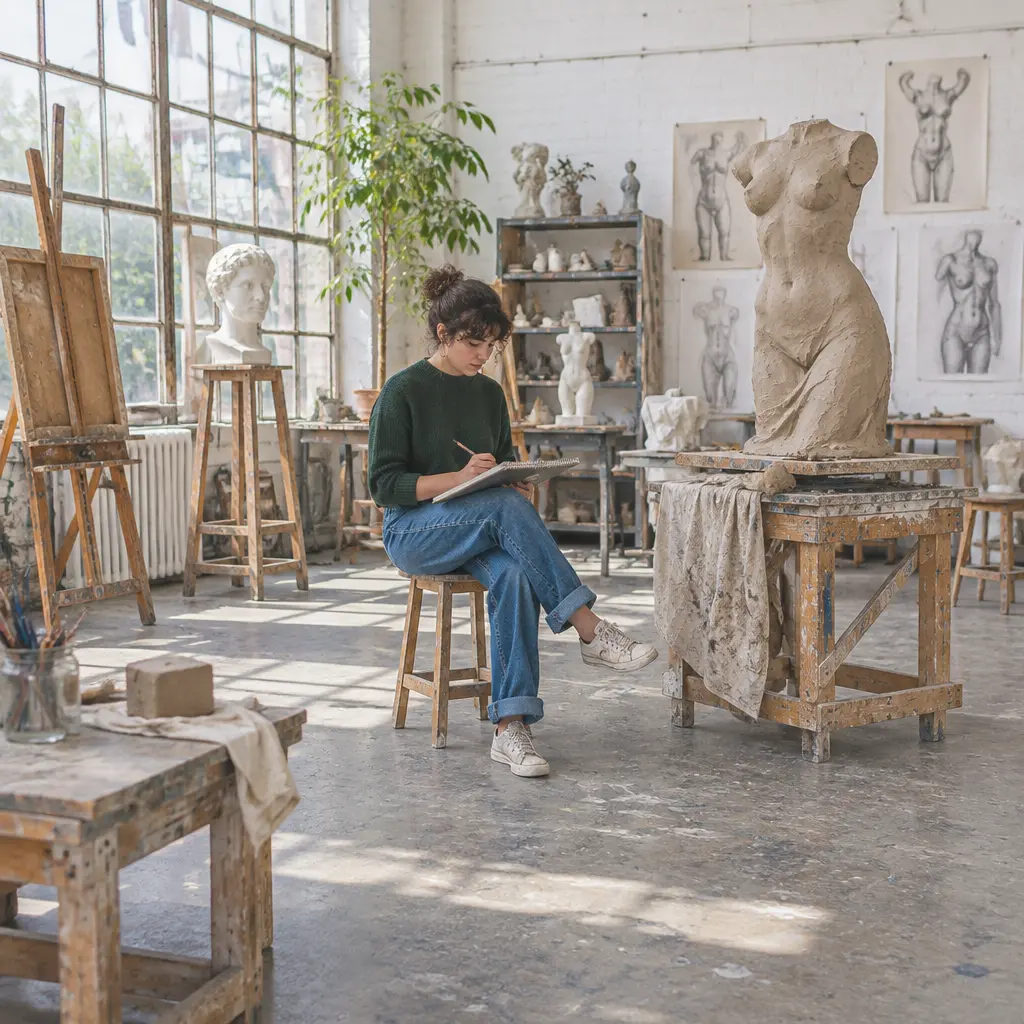
Art school is a place to develop artistic skills, ideas, and professional practices through studio work, critique, research, and collaboration. Making the most of that time means treating school not just as a sequence of assignments, but as a chance to build a sustainable creative practice and a body of work. The National Center for Education Statistics reported that U.S. degree-granting institutions awarded about 111,000 bachelor’s degrees in visual and performing arts in 2021–22, illustrating how many graduates enter a field where creative work, professional preparation, and adaptability all matter. A purposeful approach combines studio practice, thoughtful use of critique, relationships with peers and mentors, career exploration, and attention to health and finances.
Building a Consistent Studio Practice at Art School
Studio practice is the repeated process of making, reviewing, and revising work. It is more than spending long hours in a workspace: it includes setting intentions, experimenting with materials, documenting decisions, and learning from results. This definition aligns with the National Endowment for the Arts’ broad understanding of artistic practice as involving the creation and presentation of art, while emphasizing the everyday habits students can shape themselves.
A consistent practice helps students develop technical fluency and discover what questions their work can investigate. It also creates a record of experimentation that is useful in critiques, portfolios, and applications. There is no universally correct number of studio hours; workload and process vary by medium, course requirements, and individual circumstances. The goal is a repeatable rhythm that leaves room for both focused work and reflection.
Plan time around creative tasks
Time planning means identifying the next concrete action rather than writing a vague goal such as “work on my project.” A student might schedule research, material tests, a first draft, and revision as separate blocks. Breaking a project into steps makes it easier to begin and helps reveal when a task needs feedback or additional resources.
The American Psychological Association describes procrastination as a common response to difficult or unpleasant tasks, rather than simply a lack of time. For art students, smaller milestones can reduce the pressure of a blank page or unfinished sculpture. Keep a weekly calendar that includes class, studio access, meals, sleep, and deadlines; leave some flexible time for unexpected material or technical problems.
Experiment, document, and reflect
Experimentation is the intentional testing of alternatives, while documentation records how those tests were made and what they revealed. Photograph work in progress, save sketches, note material choices, and write short reflections after a session. This record can help identify recurring interests and make it easier to explain artistic decisions to instructors, collaborators, or portfolio reviewers.
Documentation is particularly useful when a project changes direction or a physical piece is temporary. The Smithsonian’s conservation and collections work illustrates the importance of recording an object’s condition, materials, and history; student documentation serves a different purpose, but similarly preserves context that may otherwise be lost. Use consistent filenames and back up digital images and notes.
Using Critique to Develop Stronger Artwork
Critique is a structured discussion of artwork that considers what is visible, how the work operates, and what possibilities might be explored next. It is not simply a verdict on whether a piece is “good.” In art education, critique can connect observation, interpretation, and revision, helping students recognize how audiences encounter their work and where their intentions are or are not legible.
The National Art Education Association’s standards emphasize creating, presenting, responding, and connecting as interrelated dimensions of visual arts learning. Critique mainly supports responding and connecting, but it can also inform the next stage of making. Moving from critique into professional relationships is natural: repeated conversations with classmates and faculty can become a valuable network of collaborators and advisers.
Give and receive specific feedback
Useful feedback describes observable features and their effects. Instead of saying “I like it,” a peer might say, “The sharp contrast draws my eye to the doorway, and I read the empty space beyond it as a separate scene.” Specific comments give the artist something to consider without dictating a single solution.
When receiving feedback, listen for patterns across several responses, ask clarifying questions, and distinguish a viewer’s interpretation from a required revision. Not every suggestion will fit the work’s purpose. A practical response is to record comments, take time to reflect, then choose one or two experiments that test whether a proposed change strengthens the piece.
Build constructive peer and faculty relationships
A creative network is a group of people who exchange knowledge, encouragement, opportunities, and professional perspectives. It often begins with classmates, instructors, technicians, visiting artists, and staff who understand the resources and expectations of a particular school. Ask thoughtful questions, follow up on advice, and offer support in return rather than treating relationships as one-way requests.
The U.S. Bureau of Labor Statistics notes that artists may work independently, on contract, or in teams, depending on their specialty. Collaboration and communication are therefore useful beyond school. Group exhibitions, shared studio projects, and student publications can help students practice crediting collaborators, meeting deadlines, and discussing creative decisions professionally.
Making the Most of Art School Resources and Career Exploration
Art school resources include facilities, equipment, libraries, advising, exhibitions, visiting-artist programs, and career services. Using them effectively means learning what is available, understanding access and safety rules, and asking for help early. These resources can broaden a student’s methods and help connect coursework to the realities of creative work.
Career exploration is the process of testing possible ways to apply artistic skills, rather than assuming there is only one route after graduation. The Bureau of Labor Statistics’ Occupational Outlook Handbook describes varied pathways across fine art, design, animation, craft, and related occupations. Its employment and wage figures differ by occupation and change over time, so students should use the handbook’s specific occupational profiles when researching current prospects.
Use facilities, collections, and exhibitions
Workshops and studios provide access to tools and processes that may be difficult to explore independently. Before using equipment, complete required training and follow safety procedures. Libraries and museum collections can support visual research by exposing students to historical examples, materials, and approaches beyond their immediate coursework.
Exhibitions offer a real-world setting for considering scale, sequencing, lighting, interpretation, and audience experience. Students can learn by visiting campus and local shows, reading labels and artist statements, and observing how work is installed. If an opportunity arises to exhibit, clarify responsibilities such as transport, installation, insurance, image permissions, and promotional materials.
Develop a portfolio and explore professional paths
A portfolio is a selected, organized presentation of work that demonstrates skills, ideas, and development for a particular audience. It is not simply a storage folder of every completed assignment. Choose pieces that communicate a clear direction, photograph them carefully, include concise captions, and tailor the selection to the opportunity—such as a residency, internship, graduate program, or design role.
Career exploration can include internships, freelance projects, teaching, arts administration, community arts, commercial work, and further study. The Bureau of Labor Statistics reports occupational outlooks separately because employment conditions vary substantially across roles. Students should compare the work itself, required skills, typical working arrangements, and local opportunities rather than relying on one broad statistic about “artists.”
Protecting Well-Being While Studying Art
Well-being is the combination of physical, mental, social, and financial conditions that supports a student’s ability to learn and create. Art school can involve intense deadlines, public feedback, physical materials, and uncertainty about future work. A sustainable approach treats rest, safety, and support as part of artistic development—not as distractions from it.
The National Institute for Occupational Safety and Health emphasizes identifying and controlling workplace hazards. Although its guidance is designed for workplaces, the principle applies in studios: understand material risks, use ventilation and protective equipment as instructed, label and store supplies properly, and consult safety staff when uncertain. Well-being also includes managing workload and seeking support before stress becomes unmanageable.
Set sustainable boundaries and seek support
Sustainable boundaries are limits that protect time, health, and attention while allowing students to meet meaningful commitments. Plan breaks, maintain regular sleep where possible, and avoid treating all-night work as a measure of dedication. If deadlines overlap, talk with instructors or advisers early about priorities and available options.
Students can use campus counseling, accessibility services, health services, peer support, and academic advising. The National Institute of Mental Health recommends seeking professional help when mental health concerns interfere with daily life or persist. Asking for support is a practical step toward staying engaged with school and creative work.
Understand materials, safety, and finances
Studio safety means recognizing risks associated with tools, dust, fumes, solvents, heat, and other materials, then following the school’s training and handling requirements. Read product labels and safety data sheets, use approved protective equipment, and do not improvise around hazardous processes. Ask technicians or instructors for guidance before using unfamiliar equipment or materials.
Financial planning is also part of making school time count. Track supply costs, transport, printing, and exhibition expenses; ask about equipment loans, grants, scholarships, and student employment. The National Center for Education Statistics’ annual tuition and student-aid data show that education costs and aid vary by institution and student circumstances, so consult the school’s current financial-aid information rather than relying on national averages alone.
Conclusion: Turn Art School into a Foundation for Lifelong Practice
Making the most of art school means building a steady studio practice, using critique as a tool for inquiry, forming reciprocal relationships, exploring resources and career paths, and protecting well-being. These habits help students make stronger work while learning how to adapt, communicate, and sustain a creative life beyond graduation.
Start with one practical action this week: schedule a focused studio session, document a work in progress, ask for specific feedback, visit an exhibition, or speak with an adviser about an opportunity. Small, deliberate choices can turn an education into a foundation for continued learning and meaningful creative work.
Sources: National Center for Education Statistics, Digest of Education Statistics, Table 322.10, Degrees conferred by postsecondary institutions by level of degree and field of study, https://nces.ed.gov/programs/digest/d22/tables/dt22_322.10.asp; National Endowment for the Arts, Arts and Cultural Production Satellite Account, https://www.arts.gov/impact/research/arts-data-profile-series/adp-31; American Psychological Association, Procrastination, https://www.apa.org/news/press/releases/2010/04/procrastination; Smithsonian, Collections, https://www.si.edu/collections; National Art Education Association, National Core Arts Standards, https://www.arteducators.org/learn-tools/national-visual-arts-standards; U.S. Bureau of Labor Statistics, Occupational Outlook Handbook: Arts and Design Occupations, https://www.bls.gov/ooh/arts-and-design/; National Institute for Occupational Safety and Health, Hierarchy of Controls, https://www.cdc.gov/niosh/hierarchy-of-controls/about/; National Institute of Mental Health, Caring for Your Mental Health, https://www.nimh.nih.gov/health/topics/caring-for-your-mental-health; National Center for Education Statistics, Tuition Costs of Colleges and Universities, https://nces.ed.gov/fastfacts/display.asp?id=76.