
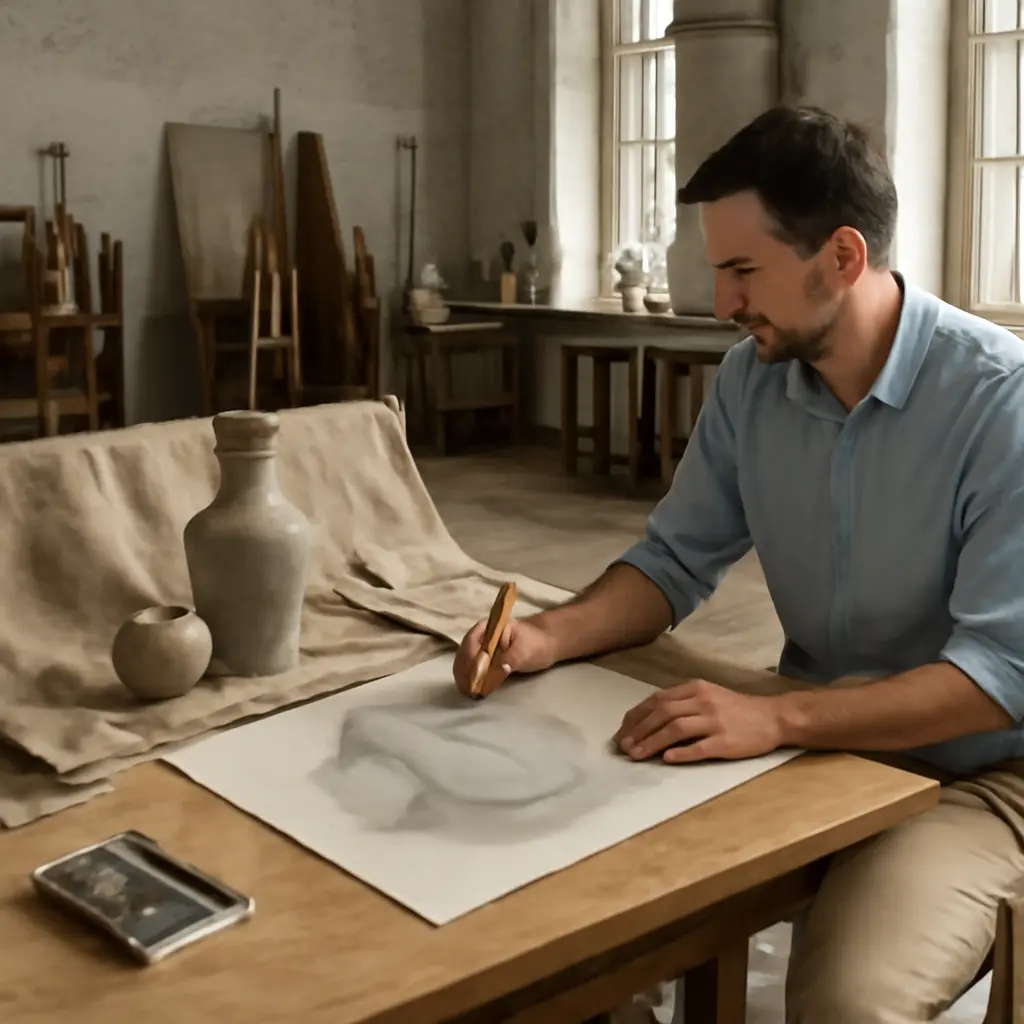
Traditional drawing develops a set of embodied skills: coordinating hand and eye, judging proportion, controlling pressure, and learning through the physical resistance of tools and paper. Digital tools can support and extend those abilities, but they do not reproduce every part of the experience. Research on drawing and cognition suggests that making images can support observation and memory, while art-education guidance emphasizes sustained practice with materials. This article explains what traditional drawing teaches, how its tactile and perceptual demands differ from digital workflows, where the evidence is strongest, and why artists benefit from learning both.
Traditional drawing builds perceptual and motor skills through physical practice
Traditional drawing is the making of marks on a physical surface with tools such as graphite, charcoal, ink, or paint. Its distinctive attribute is direct material feedback: the artist sees a mark while feeling the pressure, friction, and movement that produced it. The National Core Arts Standards describe creating as a process of developing and refining artistic work; in drawing, that process includes observing, making choices, and revising through physical action.
Traditional drawing includes several related forms, or hyponyms: observational drawing from life, gesture drawing, contour drawing, tonal studies, and studies of objects or figures. Each emphasizes a different combination of seeing, movement, and decision-making. A 2014 study by James W. Bartley and colleagues in the journal Psychology of Aesthetics, Creativity, and the Arts found that drawing information during learning improved recall compared with writing it down in the study’s tested conditions. That result supports drawing as an active way to encode information, but it does not prove that every kind of drawing practice automatically improves every cognitive skill.
Observation drawing trains visual comparison
Observation drawing means representing a subject by repeatedly comparing what is seen with what is being drawn. The artist checks angles, negative spaces, proportions, edges, and value relationships rather than relying only on familiar symbols or memory. This comparison loop can make small differences more noticeable: a shoulder may slope more sharply than expected, or the space between two objects may define their relationship more clearly than either outline alone.
The process is useful in fields that rely on visual judgment, including illustration, design, architecture, and scientific recording. A drawing is not an objective measurement by itself, but it can help a learner slow down and inspect a subject. The Getty Museum’s educational materials, for example, use close looking and drawing activities to encourage careful attention to artworks and their details.
Gesture drawing develops coordination and economy
Gesture drawing is a quick study that captures a subject’s action, direction, and overall energy rather than finished detail. It asks the hand to respond to broad visual cues while the artist makes rapid decisions about line, weight, and movement. Repeated practice can develop fluency and help artists prioritize the largest relationships before refining smaller forms.
This practice is especially common in figure drawing and animation preparation, where pose and balance must read quickly. The benefit is not simply speed: a short time limit can reveal whether a drawing communicates the subject’s action without relying on decorative detail. Like other motor skills, coordination improves through practice, although progress varies by learner and task.
Traditional drawing makes material feedback part of the learning process
Material feedback is information an artist receives through the interaction of tool, hand, and surface. Paper tooth can slow a pencil; charcoal can smudge under a palm; a brush can hold more or less pigment depending on its moisture. These sensations are not incidental: they help the artist judge pressure, speed, and the likely result of a mark.
Digital systems can simulate some of these qualities with styluses, textured screen protectors, and software brushes. However, a simulation is still mediated by a device and its settings. Traditional tools make the physical consequences of a mark immediate, including uneven coverage, accidental smears, and the need to manage the page itself. Those constraints can encourage planning and adaptation.
Pressure, friction, and tool control shape marks
Tool control is the ability to vary a mark intentionally through pressure, angle, speed, and contact. A pencil can move from a faint construction line to a dark contour; charcoal can create broad tonal passages or sharp edges. Because the surface physically resists the tool, artists receive continuous sensory cues about how their movements affect the image.
The National Art Education Association’s standards-oriented resources emphasize exploration of materials, techniques, and processes as part of art learning. This supports teaching students to understand what materials can do, rather than treating drawing as a purely visual outcome. A useful classroom comparison is to draw the same simple form with graphite, charcoal, and a digital brush, then discuss which qualities were easier to control and why.
Physical limits encourage decisions and problem-solving
A physical drawing has limits: paper can tear, ink can bleed, and erasing may leave a trace. The artist must decide whether to correct, incorporate, or accept an unexpected mark. This makes revision a visible process rather than an invisible sequence of edits, and it can build tolerance for uncertainty as well as practical resourcefulness.
Digital undo and layers are valuable, especially for experimentation and production work, but they can make some decisions feel reversible indefinitely. Traditional practice offers a complementary lesson: not every mark needs to be removed, and a drawing can develop through adjustment rather than perfect control. This is a pedagogical distinction, not evidence that one medium is inherently more creative than the other.
Traditional drawing supports memory, attention, and visual thinking
Drawing can function as a way of thinking, not just a way of presenting a finished image. When a person sketches an object, diagram, or scene, they select and organize information. Researchers have studied this relationship in learning contexts, while educators use drawing to help students represent ideas that may be difficult to explain in words.
The evidence should be interpreted carefully. Findings from a particular memory or classroom experiment do not establish that traditional drawing is universally superior to digital drawing, nor that drawing alone guarantees better learning. They do show that visual production can be an active learning strategy whose effectiveness depends on the task, instruction, and learner.
Drawing can strengthen recall through generative learning
Generative learning occurs when learners actively create or reorganize information rather than merely receiving it. In a 2014 experiment published in Psychology of Aesthetics, Creativity, and the Arts, researchers reported better recall for drawn information than for written information under the study’s conditions. The likely value of drawing is that it combines semantic processing with visual and motor activity, requiring learners to decide what features matter.
For example, a student studying a leaf can sketch its outline, vein structure, and asymmetry instead of copying a label alone. The drawing may expose misunderstandings: if the veins are placed incorrectly, the student has a concrete reason to look again. The study supports drawing as one useful learning method, not as a replacement for reading, discussion, or measurement.
Sketching externalizes ideas for analysis
An external representation is an idea made visible outside the mind, such as a sketch, map, or diagram. Drawing can help people compare alternatives, notice gaps, and communicate relationships. In design practice, rough sketches often serve as working tools: they allow a concept to be tested before time is spent on detailed rendering or fabrication.
Traditional media make this externalization especially direct because a page can be annotated, turned, folded, or placed beside a reference. Digital canvases offer their own advantages, including duplication and easy rearrangement. The core transferable skill is not loyalty to paper; it is the ability to use drawing deliberately to observe, test, and explain an idea.
Traditional drawing and digital workflows teach complementary skills
Digital drawing is image-making through electronic devices and software, commonly using a graphics tablet, touchscreen, or stylus. Its strengths include layers, undo, selection, scalable resolution, and rapid variation. Traditional drawing’s strengths include direct contact with physical materials, low setup requirements in many contexts, and a clear relationship between gesture and mark. Neither list makes one medium universally better; the appropriate choice depends on the task.
The Bureau of Labor Statistics’ Occupational Outlook Handbook describes graphic designers as working with digital tools to create visual concepts, while fine artists may use a range of media. These descriptions reflect contemporary practice: artists often move between sketchbooks and software rather than choosing one permanently. Learning traditional fundamentals can make digital decisions more purposeful, while digital tools can help artists revise, combine, and distribute work efficiently.
What digital tools add—and what they do not reproduce exactly
Digital tools add efficient correction, non-destructive editing, color experimentation, and straightforward file sharing. Pressure-sensitive styluses can vary line width, and brush engines can imitate media. These features are valuable for professional workflows and do not diminish the artistic skill involved in using them.
At the same time, a screen-based brush does not necessarily reproduce the exact friction, absorbency, smell, sound, or physical risk of graphite, ink, or paper. The differences matter when the learning goal is to understand how a particular material behaves. A productive exercise is to make one study on paper and one digitally, then compare control, revision, attention, and the qualities each medium makes possible.
A blended curriculum prepares artists for varied practice
A blended curriculum teaches foundational drawing alongside digital production. Students might begin with observational studies and gesture exercises, then scan or photograph their work for digital refinement. This sequence preserves the physical practice of looking and mark-making while introducing the technical skills needed for contemporary illustration, design, and communication.
The National Core Arts Standards provide a useful framework by emphasizing creating, presenting, responding, and connecting. In practical terms, learners can create a physical study, present a revised digital version, respond to differences in clarity and expression, and connect their choices to audience and purpose. The approach treats media as tools with distinct affordances rather than as competing identities.
Conclusion: Traditional drawing remains essential because it teaches through doing
Traditional drawing develops visual comparison, hand-eye coordination, material awareness, and a willingness to make decisions with imperfect tools. Research on drawing and recall offers evidence that image-making can support learning in specific settings, while art-education frameworks reinforce the importance of exploring materials and refining work. These benefits do not mean digital workflows are inferior; they show that some parts of physical practice are difficult to reproduce exactly on a screen.
For students, educators, and working artists, the practical next step is to include both media: draw from observation on paper, study how tools respond, and then use digital workflows where editing or delivery demands them. Further reading from the National Core Arts Standards, the Getty Museum’s art-learning resources, and research on drawing as a learning strategy can help readers design a balanced practice.
Sources: National Core Arts Standards, National Core Arts Standards: Visual Arts, https://www.nationalartsstandards.org/; Bartley, James W., et al., “The Drawn Memory: Drawing as a Powerful Memory Aid,” Psychology of Aesthetics, Creativity, and the Arts, 2014, https://doi.org/10.1037/a0036778; Getty Museum, Education Resources, https://www.getty.edu/education/; National Art Education Association, National Visual Arts Standards, https://www.arteducators.org/learn-tools/national-visual-arts-standards; U.S. Bureau of Labor Statistics, Occupational Outlook Handbook: Arts and Design Occupations, https://www.bls.gov/ooh/arts-and-design/