
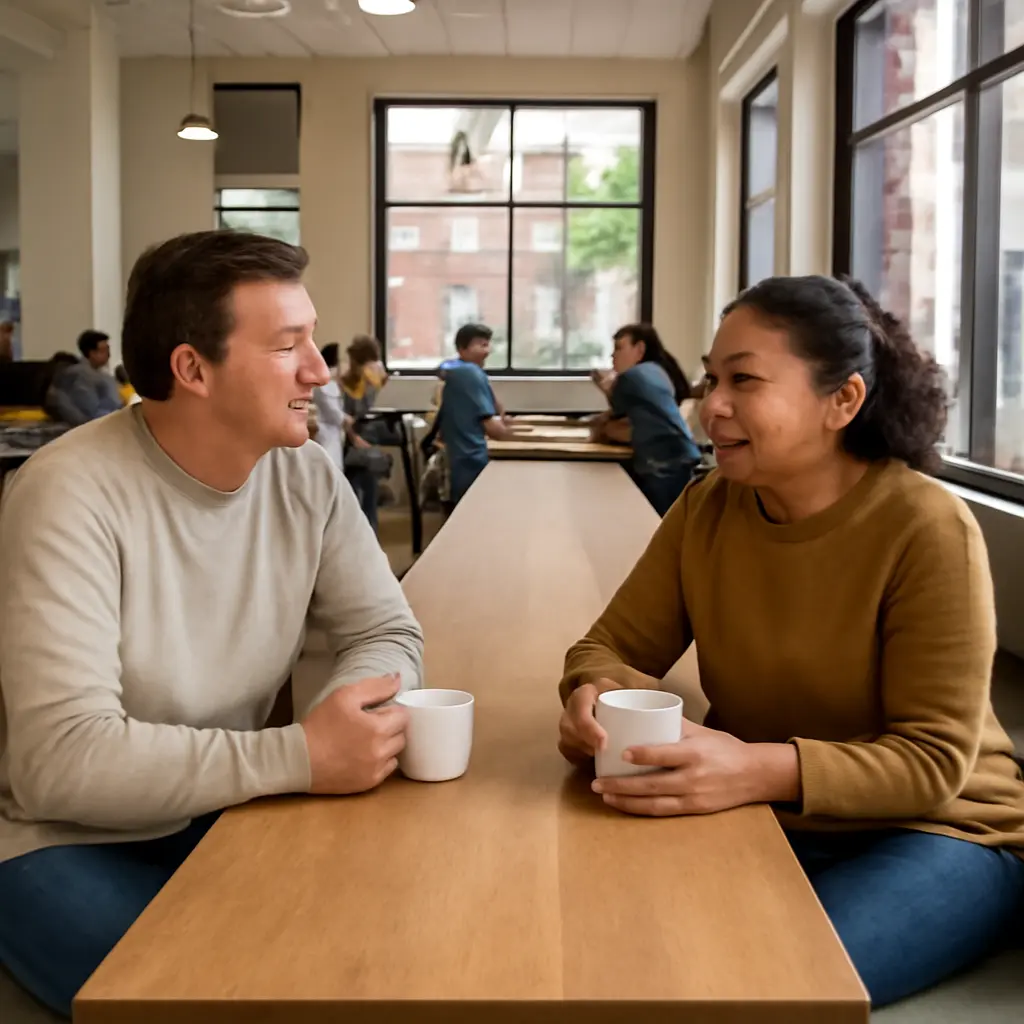
A social venue is more than a backdrop for conversation: it is a setting whose layout, sound, rules, and shared purpose can shape who speaks, how long they talk, and what feels appropriate to say. Research in environmental psychology and sociology suggests that bars, cafés, libraries, parks, and community spaces influence conversation through both physical design and social expectations. These effects matter as people increasingly use public and semi-public places to meet, work, and build community. The evidence below explains how venue design steers talk, how noise and activity alter interaction, and how social norms and real-world examples reveal the unexpected subjects people actually discuss.
Venue design shapes conversational behavior
Venue design is the arrangement of physical features—such as seating, boundaries, lighting, entrances, and pathways—that helps structure activity and interaction. Environmental psychologist Robert Gifford describes environmental psychology as the study of transactions between individuals and their physical settings; applied to social venues, this means a room can influence behavior without explicitly dictating it. Design tends to change the likelihood and form of interaction, rather than determine a conversation’s exact topic.
The key design variables include proximity, visibility, privacy, and movement. A 1976 study by Thomas Allen of communication among research and development workers found that the probability of communication fell sharply as the distance between coworkers increased, becoming particularly low beyond roughly 30 meters. Though the research examined workplaces rather than cafés or pubs, it illustrates a broader principle: who is near whom—and whether people can see one another—can affect who exchanges information. The same logic helps explain why a long communal table encourages encounters that separate booths usually do not.
Seating arrangements and conversational boundaries
Seating arrangement is the positioning of chairs and tables in relation to other people and to the room. Face-to-face seating supports direct exchange; adjacent seating can make shared attention—toward a stage, screen, or street—the focus; and circular arrangements can make it easier for a group to share turns. These are tendencies, not universal rules: culture, familiarity, accessibility needs, and the purpose of a visit all matter.
A café’s communal table can turn a private conversation into a more permeable one: strangers may exchange practical information, comment on a shared event, or politely avoid contact while remaining within earshot. A booth, by contrast, creates a visible boundary and often supports longer, more personal talk. Sociologist Ray Oldenburg’s concept of the “third place”—a setting outside home and work where people gather informally—helps explain why cafés, pubs, and similar venues can foster repeated, low-pressure contact. In his account, accessibility and regular attendance are part of what makes such places socially useful.
Visibility, privacy, and the choice of topic
Privacy is the degree to which people can control who sees or hears an interaction. In open venues, conversations may shift toward broadly acceptable subjects—local events, food, work, or observations about the room—because nearby listeners are present. More enclosed spaces can make sensitive topics feel safer, although acoustic privacy depends on materials, distance, and background sound as well as walls.
This helps explain why the same group may talk differently at a crowded food hall than in a quiet corner booth. The venue offers cues about audience and exposure. In libraries, for example, quiet rules make even necessary exchanges brief or whispered; in a sports bar, a game supplies a shared subject that can make conversation among strangers feel natural. The setting does not write the script, but it can make some subjects easier to start than others.
Venue sound and activity reshape what people say
Acoustic conditions are the sound levels and sound patterns that people encounter in a venue, including music, conversation, traffic, and reverberation. They affect intelligibility, effort, and the feasibility of sustained discussion. The World Health Organization’s 2018 environmental-noise guidelines identify noise as a health concern and recommend reducing exposure to harmful levels. For everyday social talk, the practical point is straightforward: when speech is hard to hear, people may repeat themselves, shorten exchanges, or choose topics that require less nuance.
Background noise and conversational effort
Background noise is sound that competes with a speaker’s voice. It can prompt people to speak louder—the “Lombard effect”—and can make listeners rely more heavily on context and facial cues. In a noisy bar, a quick joke or a comment about the music may work better than a detailed account of a complicated problem. In a quiet tea room, by contrast, the lower effort required to hear one another can support longer, more reflective exchanges.
A 2010 study by Jonas Söderlund, Stefan Sikström, and Andrew Smart found that moderate background noise could improve performance on a creative-thinking task compared with very quiet or very loud conditions. The result does not mean that noise reliably improves conversation, nor that a particular decibel level guarantees creativity. It does underscore that sound can influence mental effort and task performance in ways that may spill over into how people brainstorm or discuss ideas. A useful figure for readers would compare venue types by noise level and typical conversational task, while making clear that actual conditions vary.
Shared activities provide ready-made subjects
A shared activity is an event or task that gives people a common point of attention. Watching a match, attending a lecture, waiting for food, or browsing a market can supply an easy opening and reduce the pressure to invent a topic. Conversation often moves from the activity itself to personal stories, opinions, and local knowledge once participants have established common ground.
Sports venues make this dynamic especially visible: the game creates a continuously changing subject, and reactions can be shared even by people who have never met. At farmers’ markets, the objects for sale invite questions about ingredients, growing methods, and recipes. The activity therefore shapes not only whether people interact but also the sequence of topics—starting with what everyone can see, then potentially moving toward personal experience.
Venue norms and social roles guide conversational content
Venue norms are the informal or formal expectations attached to a place, including rules about noise, behavior, dress, participation, and who is welcome. Sociologist Erving Goffman’s work on social interaction emphasizes that people manage impressions and adjust their conduct to a situation. A venue’s identity helps define that situation: people may expect debate at a public forum, discretion in a clinic waiting room, and casual small talk at a neighborhood café.
Third places and repeated encounters
Third places are informal gathering places distinct from home and work, a term popularized by Oldenburg. Their recurring visitors may develop recognition and familiarity over time, turning brief greetings into ongoing conversations about neighborhood changes, family news, or shared concerns. This is one reason regular venues can create social ties without requiring a formal club or scheduled meeting.
The American Time Use Survey, conducted by the U.S. Bureau of Labor Statistics, provides a broader measure of social life: in 2023, people age 15 and older spent an average of about 34 minutes per day socializing and communicating. That national average includes time in many settings and does not show that a particular venue causes conversation. It does, however, help establish that social interaction is a meaningful part of everyday time use—and that places which make informal contact easier may matter to community life.
Institutional venues and role-based talk
Institutional venues are settings organized around a service or formal purpose, such as schools, clinics, libraries, and government offices. Their roles influence what people feel entitled or expected to discuss. A library can support quiet peer learning as well as reading; a clinic may make health the central topic while also exposing visitors to the discomfort of being overheard; and a school hall can shift quickly from casual conversation to teacher-directed exchange.
A venue’s rules can also shape who gets heard. In a community meeting with fixed speaking turns, participants may raise public issues that would be difficult to introduce in casual conversation. In a waiting room, people may avoid conversation because they do not know one another or because the setting feels sensitive. These examples show why “social venue” is not a single category: purpose, authority, and perceived privacy distinguish one kind of talk from another.
Real-world examples show how venues redirect conversation
The strongest account of venue effects combines design, sound, activity, and norms rather than attributing conversation to a single feature. A café can be noisy but socially welcoming; a library can be quiet but encourage collaborative study in designated areas; and a park can support both solitary recreation and spontaneous interaction. The following examples illustrate how those forces work together.
Cafés: from practical talk to creative exchange
Cafés combine a public atmosphere with the option to remain alone, making them useful for both brief encounters and extended visits. Ordering and sharing tables create low-stakes openings, while coffee, work, neighborhood life, and current events offer accessible subjects. The setting can also attract people working independently, so conversations may begin as practical requests—asking to share an outlet or watch a bag—and develop into professional or creative exchange.
This pattern should not be romanticized: crowding, cost, noise, and expectations about purchasing can exclude some visitors. Still, the café demonstrates how a venue’s combination of repeated presence, shared services, and flexible participation can make conversation possible without requiring everyone to attend for the same reason.
Parks and public squares: conversation through shared space
Parks and squares support activity-based contact—walking dogs, supervising children, playing sports, or attending an event—alongside conversation among people who may not otherwise meet. The Project for Public Spaces, drawing on urbanist William H. Whyte’s observations of public life, emphasizes that seating, edges, sunlight, and opportunities to watch activity affect how people use public places. These features can create settings where conversation emerges around a shared view or recurring routine.
A park’s openness may encourage casual greetings but offer little acoustic or visual privacy. Discussions may therefore stay light unless people know one another or move to a more secluded spot. Public space can widen the range of possible encounters, while its exposure can limit the depth of some conversations.
Libraries and community centers: designed opportunities for exchange
Libraries and community centers often contain multiple social zones: quiet areas, classrooms, meeting rooms, counters, and informal seating. That variety allows the same institution to support distinct conversations, from whispered assistance and study discussion to public workshops and neighborhood planning. The American Library Association’s guidance on library space planning treats flexibility and user needs as important considerations, reflecting a practical recognition that a building serves more than one kind of interaction.
The design lesson is that venues can offer choices rather than impose a single conversational mode. A quiet room protects concentration, while a book club room makes discussion expected. A community center’s accessible meeting space can help residents deliberate about local needs. In each case, layout and purpose combine to signal what kinds of talk belong there.
Conclusion: social venues influence conversation without dictating it
Social venues shape what people actually talk about through design, acoustic conditions, shared activities, and social norms. Seating affects proximity and privacy; sound changes the effort required to communicate; common events supply ready-made topics; and institutional or community expectations influence what feels appropriate to say. Research on communication distance, noise, public-space use, and everyday time use supports the importance of these factors, while also cautioning against treating a setting as the sole cause of conversational behavior.
For venue designers, community organizations, and anyone choosing a place to meet, the practical takeaway is to match the environment to the desired interaction: provide options for both lively exchange and quieter conversation, make shared activities easy to join, and consider accessibility and privacy. To explore the subject further, compare how people use different zones in a local café, library, or park—and notice how the setting changes the conversation before anyone consciously chooses a topic.
Sources: Robert Gifford, Environmental Psychology: Principles and Practice, 5th edition, 2014, https://www.optro.org/; Thomas J. Allen, Managing the Flow of Technology: Technology Transfer and the Dissemination of Technological Information within the R&D Organization, 1977, https://mitpress.mit.edu/9780262510340/managing-the-flow-of-technology/; Ray Oldenburg, The Great Good Place, 1989, https://www.dacapopress.com/titles/ray-oldenburg/the-great-good-place/9781569246818/; World Health Organization, Environmental Noise Guidelines for the European Region, 2018, https://www.who.int/europe/publications/i/item/9789289053563; Jonas Söderlund, Stefan Sikström, and Andrew Smart, “Listen to the Noise: Noise Is Beneficial for Cognitive Performance in ADHD,” Journal of Child Psychology and Psychiatry, 2010, https://doi.org/10.1111/j.1469-7610.2009.02176.x; U.S. Bureau of Labor Statistics, American Time Use Survey—2023 Results, 2024, https://www.bls.gov/news.release/atus.nr0.htm; Project for Public Spaces, “What Makes a Successful Place?”, https://www.pps.org/article/grplacefeat; American Library Association, Library Space Planning, https://www.ala.org/tools/future/trends/libraryspace