
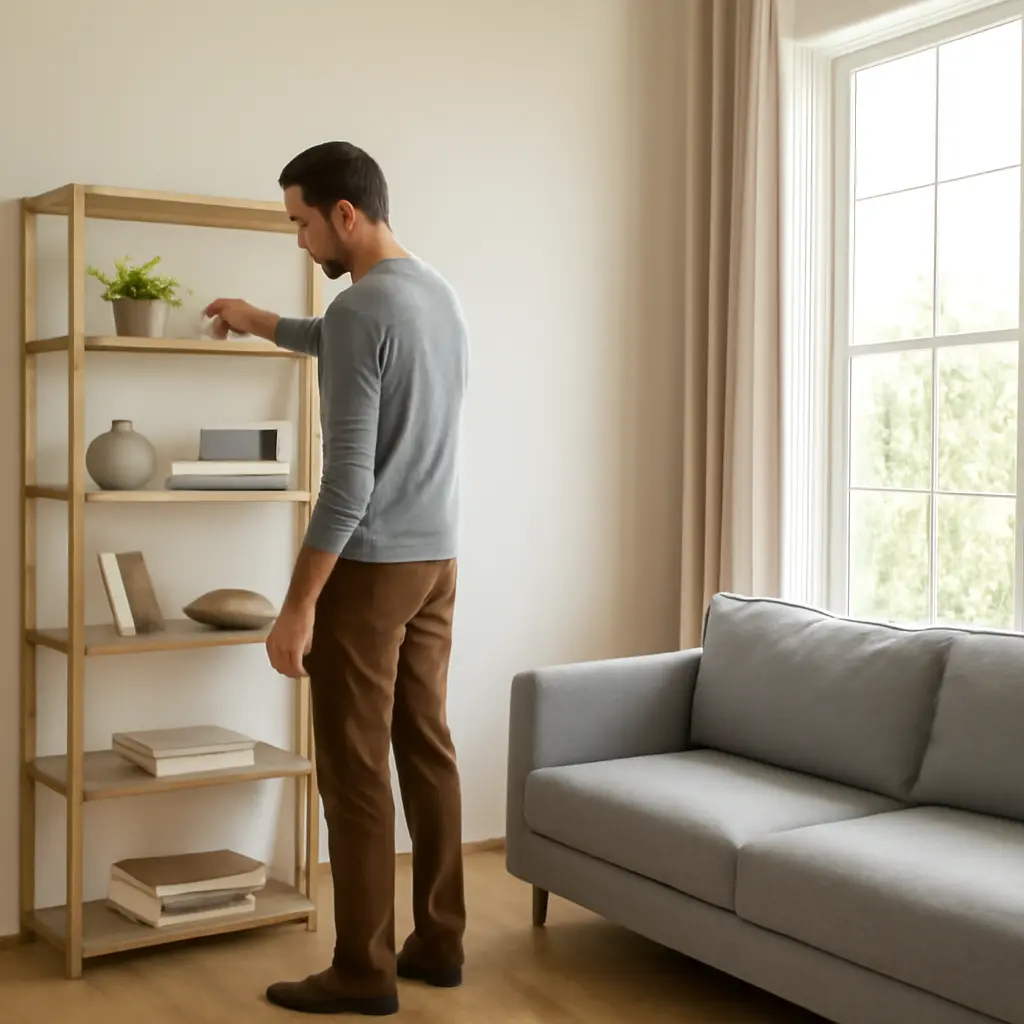
Deleting instead of decorating is a design strategy: remove visual elements that do not help a space work, feel, or communicate better, rather than adding more objects to improve it. In interiors, this can make rooms feel calmer, clarify their purpose, and reveal useful space that decoration was obscuring. The approach is not a rule to own as little as possible; it is a deliberate way to evaluate clutter, function, visual attention, and the environmental cost of buying. Research on clutter and attention offers reasons to take the idea seriously, while practical examples show how to apply it without making a home feel bare.
Design strategy and the “delete, don’t decorate” principle
“Delete, don’t decorate” is best understood as an editing principle, not a formal design doctrine with one universally accepted definition. It means first removing or relocating items that create visual noise, obstruct movement, duplicate a function, or lack meaning; only then should someone consider adding decor. The principle resembles “less but better,” a phrase associated with industrial designer Dieter Rams, and connects with minimalism, decluttering, adaptive reuse, and functional interior design.
The distinction matters: deleting is an active design choice, not simply leaving a room unfinished. A clear surface can emphasize the object that remains, make a task easier, or give the eye a place to rest. Conversely, removing everything indiscriminately can strip a home of comfort, personal history, and practical tools. The aim is intentional selection.
Visual clutter and attention
Visual clutter is an accumulation of competing objects, patterns, or information that makes it harder to identify what matters in a scene. In a 2011 study published in the Journal of Neuroscience, researchers at Princeton University found that multiple visual stimuli compete for neural representation, and that clutter can make it harder to focus on a particular target. The study examined visual attention rather than home decorating specifically, so it supports a general explanation of why busy scenes can be demanding—not a claim that every decorated room harms concentration.
Applied at home, the idea suggests editing around the task. A desk used for writing may benefit from fewer objects in its immediate field of view, while a collection displayed intentionally can serve as a meaningful focal point. The question is not whether an object is decorative, but whether its visual presence contributes enough to justify the attention it takes.
Function, circulation, and breathing room
Functional editing removes items that interfere with how a room is used: a chair that blocks a doorway, excess furniture that narrows a route, or countertop accessories that make food preparation difficult. “Negative space”—the unoccupied area around objects—is not wasted space. It helps define a room’s layout and can make the remaining furnishings easier to see and use.
This connects deletion to universal design, which seeks environments that are usable by a wide range of people. Clear paths and accessible surfaces can help residents with mobility limitations, families with young children, and anyone carrying groceries or laundry. Removing an obstacle may improve a room more than adding a new piece of furniture.
The effects of deleting instead of decorating
The effects depend on what is removed and why. Editing can improve visual hierarchy—the order in which a viewer notices elements—while reducing maintenance and making existing possessions more useful. It can also prevent unnecessary purchases. That last benefit connects the interior-design decision to material consumption: choosing not to buy an item avoids the resources and waste associated with producing, packaging, and transporting it.
Calmer rooms and perceived order
A room with fewer competing focal points can feel more ordered because its dominant features are easier to interpret. This does not mean every room should be sparse. A patterned rug, books, artwork, and family objects can coexist when they have a clear arrangement and leave enough visual breathing room. The useful test is whether the room’s main purpose and focal point are easy to recognize.
Research should be interpreted carefully here. A 2010 study in Personality and Social Psychology Bulletin by researchers at the University of California, Los Angeles, examined the relationship between descriptions of home environments and cortisol patterns among 30 dual-income families. The authors reported that women who described their homes as more stressful or cluttered showed patterns associated with less healthy daily cortisol rhythms. This small, specific study does not prove that removing decor improves health; it does show why the experience of the home environment merits attention.
Lower spending and less material waste
Deleting first can interrupt the cycle of treating every design problem as a shopping problem. If a room feels crowded, buying baskets or extra shelving may simply store more possessions; if the real issue is excess, removing or donating items may be more effective. The U.S. Environmental Protection Agency reported that the United States generated 292.4 million tons of municipal solid waste in 2018, of which 69 million tons were recycled and 25 million tons were composted. Those figures cover all municipal waste, not home decor specifically, but they provide context for the broader value of buying thoughtfully and extending the use of existing goods.
A practical low-waste sequence is to reuse, repair, sell, or donate suitable belongings before discarding them. Deletion does not have to mean sending items to landfill. Nor should it become pressure to replace functional possessions with a supposedly perfect minimalist aesthetic.
Personal meaning without visual overload
Meaningful objects can be more powerful when displayed selectively. A few photographs, a handmade bowl, or a travel memento may tell a clearer story than a crowded assortment in which every item competes for attention. Rotating collections seasonally is one way to preserve sentimental value while limiting what occupies shelves and surfaces at one time.
This is where editing differs from rigid minimalism. Minimalism is a broad design and lifestyle approach that often emphasizes reduction; “delete, don’t decorate” is a decision-making sequence that can work in a maximalist, traditional, or eclectic room. The standard is relevance, not a fixed number of objects or a particular color palette.
How to apply the principle room by room
A useful edit starts with observation rather than a shopping list. Identify what the room is for, notice what interrupts that use, and make changes gradually so that useful or beloved items are not removed by mistake.
Entryways and living areas
In an entryway, keep the essentials visible and reachable: a place for keys, shoes, coats, and bags. Remove decorative pieces that narrow the route or collect items without serving a purpose. In a living area, try temporarily clearing one surface or moving one piece of furniture. If circulation improves and the room feels easier to use, the change may be more valuable than adding another accent table or ornament.
Kitchens and workspaces
Kitchens benefit from keeping frequently used tools accessible while relocating rarely used appliances and decorative objects that occupy preparation space. A workspace can be edited around its primary task: retain the equipment and references needed for the work, and move unrelated items outside the immediate visual field. These are practical applications of the attention and circulation principles, not guarantees of improved productivity.
Bedrooms and personal collections
In a bedroom, consider whether objects on bedside tables and dressers support rest or routine. Removing unnecessary items may simplify cleaning and make the room feel more restful to its occupant. For collections, choose a defined display area and rotate pieces instead of placing everything on view. Keep accessibility, personal attachment, and household needs in mind; a visually simple room is not automatically a better room for everyone.
A practical delete-before-you-decorate method
The following process turns the idea into a reversible design experiment:
- Define the room’s main use and identify one specific frustration, such as a blocked path or crowded counter.
- Remove or relocate items that obstruct that use, duplicate a function, or have no clear place.
- Set aside uncertain belongings rather than discarding them immediately; review them after a trial period.
- Observe the room in daylight and during its normal routines. Note whether movement, cleaning, or focus has improved.
- Add something only if a clear need remains, and choose an item that solves it without creating a new obstruction.
For example, if a living-room shelf feels chaotic, first remove items that are broken, unused, or unrelated to the display. Group the remaining books and objects, leave some shelf space empty, and live with the arrangement before buying storage or additional decor. The result may reveal that the room needed editing, not more containers.
Conclusion: make room for what matters
Deleting instead of decorating is a practical way to improve a space by clarifying attention, supporting its function, and avoiding purchases that do not solve the underlying problem. Research on visual attention and home environments provides relevant context, while waste data underscores the value of thoughtful consumption; none of these sources proves that sparse interiors are universally healthier or more attractive. The strongest approach is selective: preserve useful and meaningful belongings, remove what gets in their way, and decorate only when a genuine need remains. Try editing one surface or pathway first, then judge the change by how well the room works for the people who use it.
Sources: Beck, Diane M. and Sabine Kastner, “A neural basis for pop-out effects in visual search: evidence from functional magnetic resonance imaging,” Journal of Neuroscience, 2011, https://www.jneurosci.org/content/31/37/13552; Saxbe, Darby E. and Rena Repetti, “No place like home: home tours correlate with daily patterns of mood and cortisol,” Personality and Social Psychology Bulletin, 2010, https://journals.sagepub.com/doi/10.1177/0146167210368312; U.S. Environmental Protection Agency, National Overview: Facts and Figures on Materials, Wastes and Recycling, https://www.epa.gov/facts-and-figures-about-materials-waste-and-recycling/national-overview-facts-and-figures-materials.